

The demand for highly trained clinical embryologists continues to grow across the UK and internationally. Assisted reproductive technology (ART) is evolving rapidly, and the sector requires professionals who are not only scientifically skilled, but trained within real-world clinical environments.
In response to this need, Care Fertility and Liverpool John Moores University (LJMU) launched the UK’s first academic–industry MSc in Clinical Embryology in 2022 — a programme designed to bridge the gap between university education and clinical practice.
This partnership reflects a shared commitment to innovation, workforce development, and excellence in reproductive science.
A genuine academic–industry collaboration
The MSc in Clinical Embryology is delivered through a joint model that integrates LJMU’s academic expertise with Care Fertility’s national clinical network.
LJMU provides university-based teaching in Liverpool through the School of Pharmacy and Biomolecular Sciences, drawing on its strong research reputation and international reach. Care Fertility contributes specialist teaching across several postgraduate modules, including practical laboratory training and research supervision.
Students attend Care Fertility Manchester for three full modules, learning within a regulated IVF clinic environment. Teaching is delivered by practising embryologists, reproductive scientists, and fertility consultants who are actively working in assisted reproductive technologies.
This ensures the curriculum remains aligned with current UK clinical standards, laboratory practice, and regulatory requirements.
Embedding practical laboratory experience
Clinical embryology is a discipline rooted in precision laboratory work. For this reason, the programme includes full-day practical training in Care Fertility’s purpose-built training laboratory facilities, equipped to mirror a working IVF laboratory.
Students observe and gain experience in procedures including:
- Egg collection
- Embryo grading
- Intracytoplasmic sperm injection (ICSI)
- Vitrification
- Embryo biopsy
- Andrology techniques
The opportunity to observe procedures in a live IVF setting — and then apply laboratory-based elements in a structured training environment — provides graduates with workplace-ready skills.
Students document their experience through reflective practice, preparing them for progression into the UK’s Scientist Training Programme (STP) or recognised equivalence routes.
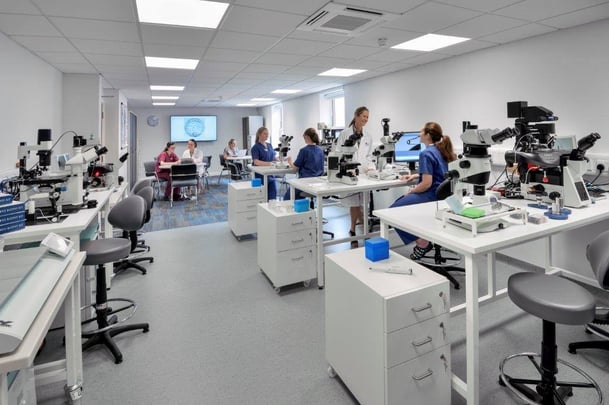 The LJMU and Care Fertility MSc in Clinical Embryology cohort undertaking practical laboratory training within Care Fertility’s clinical environment.
Connecting science with patient pathways
A distinguishing feature of the programme is the ability for students to follow patient journeys through the clinic — from referral and investigation through to treatment cycles and outcomes.
This approach ensures graduates understand not only laboratory technique, but also the broader clinical and ethical context in which embryology operates. It reinforces the importance of precision, regulation, and patient-centred practice in modern fertility services.
Research with real-world application
With a network of clinics and more than 150 scientists across the UK, Care Fertility provides extensive opportunities for clinical research projects.
Students may undertake laboratory-based projects within Care Fertility clinics or conduct large dataset analyses designed to improve IVF technologies and treatment outcomes. These projects are directly relevant to current clinical challenges and future innovation.
In the first three years of the programme:
- 14 student abstracts were submitted to the UK Fertility Conference
- 100% were accepted
- 5 were presented orally
- 4 as rapid-fire presentations
- 5 as poster presentations
This level of engagement demonstrates both academic rigour and professional relevance, providing graduates with early exposure to national scientific forums and professional networks.
Supporting workforce development in reproductive science
Graduate outcomes reflect the programme’s alignment with sector needs.
Of the first 41 graduates:
- 12% secured places on the Scientist Training Programme
- 41% moved directly into IVF laboratory roles
- Over 50% entered embryology training posts
- 27% progressed into related fields including animal embryology laboratories, sperm banks, and patient services
These outcomes illustrate the value of structured academic–clinical collaboration in preparing skilled professionals for the fertility sector.
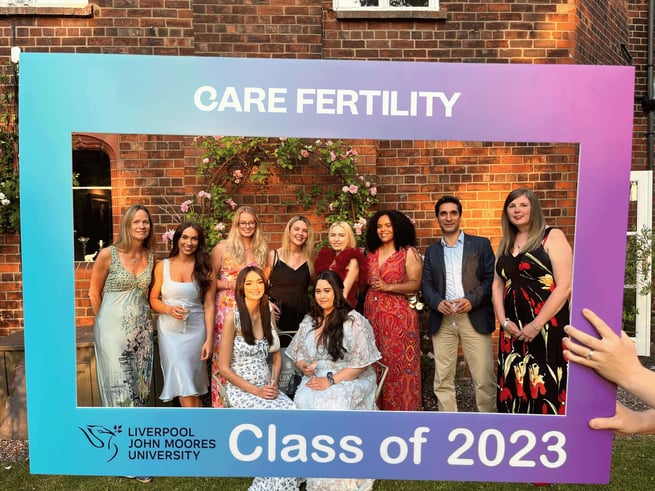 The 2023 cohort of the LJMU and Care Fertility MSc in Clinical Embryology celebrating their graduation and the completion of the programme.
Strengthening the future of clinical embryology
The partnership between LJMU and Care Fertility demonstrates how universities and healthcare providers can work together to address workforce challenges, strengthen research translation, and maintain high professional standards within assisted reproductive technologies.
By combining academic rigour with hands-on clinical exposure, this MSc in Clinical Embryology supports the development of the next generation of embryologists — professionals equipped to meet the evolving needs of patients, clinics, and the wider fertility sector.
For further information about the programme or to explore partnership opportunities, please contact Dr Sue Montgomery, Head of Postgraduate Scientific Education at Care Fertility, at sue.montgomery@carefertility.com